



Enterprise IT and ISV developers are intrigued by technology benefits of containers and Kubernetes. However, when they go with a recommendation to their senior management to containerize applications, one question is asked – Why do we need to containerize? Didn’t we rehost our application to the cloud?
Top management realizes, migration to the cloud is inevitable, and mandates moving applications to cloud. Applications that were easy to migrate, have been moved to cloud. As per Forrester Research, 78% of applications are still non-cloud. Inadequate budget and longer time to refactor are big challenges for enterprises, they are struggling! Rehosting and Refactoring (two Rs of the 6Rs of migration to cloud) are the two methods which cover the majority of applications migrated to cloud.
More on Migration Methodology
Rehosting (a.k.a. Lift and Shift) is the easiest method chosen to move apps to cloud. Few months or quarters down the line, when the CFO asks for ROI, there is a huge gap between planned versus actual cost. In rehosting, hosts are moved from datacenter to cloud (replicating existing infra). The infra needs to be optimized over a period of time, however, the applications are not optimized for cloud.
The 4 Steps of Lift & Shift 
Refactoring of an application can primarily be done at two levels:
#1. Code level
#2. Process level.
Refactoring application at code level is a long drawn process which also requires a lot of budgets. However, refactoring of applications at process level is quick and with lesser budget.
CloudHedge’s Automated Refactoring Process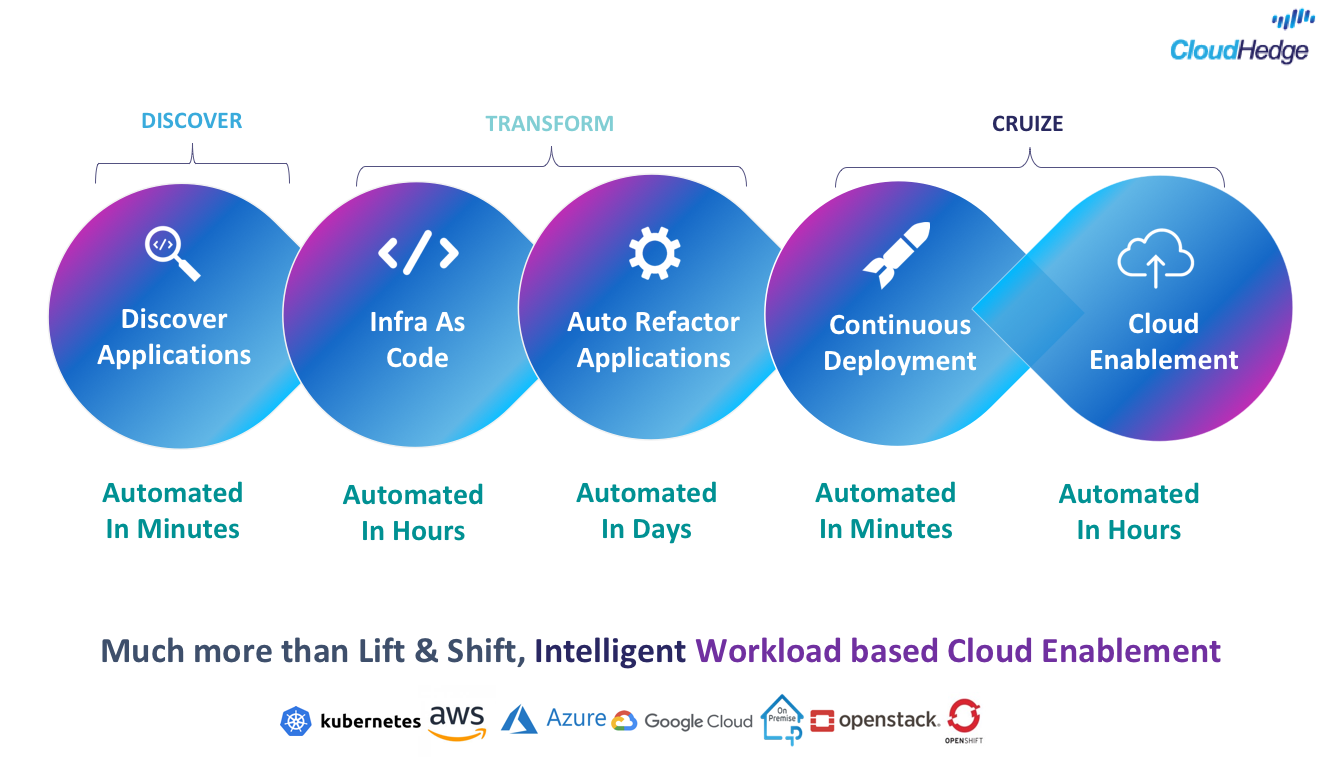
Dev and Ops teams acknowledge the advantages of containers, however, how does that translate to business benefits? CloudHedge.io automates identification and transformation of application processes. Each process can be containerized and checked into repository before deploying it on Kubernetes cluster.
So, is there a tool which refactors applications and empowers the developer to quickly release new features or fix bugs without spending a lot of time and money? Yes, CloudHedge.io automates applications to be refactored and deployed on cloud (private or public or hybrid).
Months after migrating applications to cloud, it becomes difficult to sustain its costs because of the pricing model. CFO’s are in dire straits as to why the migration was done in the first place when the bills are shooting over its OpEx budgets. In such scenarios, CloudHedge can refactor applications to containers and reduce operating costs.
Business Success from Containerization
Most enterprises would refactor apps in months, CloudHedge automates the entire migration and deployment process to reduce the timeline from months to weeks or days. CloudHedge further enables enterprises to save on the operating costs of the application, a must for SMBs who want to leverage the benefits of cloud.
Here are few business benefits provided by containerization of applications on cloud:
- Lesser footprint lesser cost: One of the top benefits of containerization is experiencing a reduction in infrastructure costs. Since containers function independently on any operating systems, they are relatively inexpensive to run and maintain.
- Enhanced Business Agility: Containers create an agile infrastructure which allows developers to quickly make changes without hampering the application workflows. Moreover, there is absolutely no need to overhaul the entire system to make changes, complex applications can be split into microservices to mitigate failure.
- Reduction in Production Time: Containerization provides the right tools for DevOps which enable quick and efficient code releases without hampering productivity. There is no need for DevOps engineers to spend valuable production time in reconfiguring the development, they can rather focus on coding as the given tools are updated on regular basis and have the capabilities to solve issues.
- Higher ROI and Customer Satisfaction: Containers are simplified and ensure quicker delivery of products, upgrades and features which contribute to an increase in revenue and customer satisfaction. In addition, producing multiple apps and testing them at the same time in containers is possible further minimizing costs.
- Multi-Cloud Platforms – One of the greatest benefits of containers is their portability feature. Containers can be fully deployed on Microsoft Azure, Google Cloud Platform (GCP), Amazon Web Services (AWS), Red Hat OpenShift, and similar platforms. Enterprises or SMBs can select the platform based on their cloud strategy.
- Security – Applications running in containers are completely segregated and isolated from each other, moreover, they also provide a complete control over traffic flow and management. From an architectural perspective, every container has its own security setup and gets its own set of resources which are highly robust and secured.
Migrating legacy apps to the cloud is no more a distant dream but a costly affair if not done in the right manner. With automated containerization of applications, enterprises can reap the benefits through CloudHedge’s Discover, Transform, and Cruize products. It simplifies the entire migration process and enables enterprises to optimize applications.
Reach out via hello@cloudhedge.io and explore new ways to automate application migration to cloud.